This is the English version of an article first published in Polish: read the Polish original.
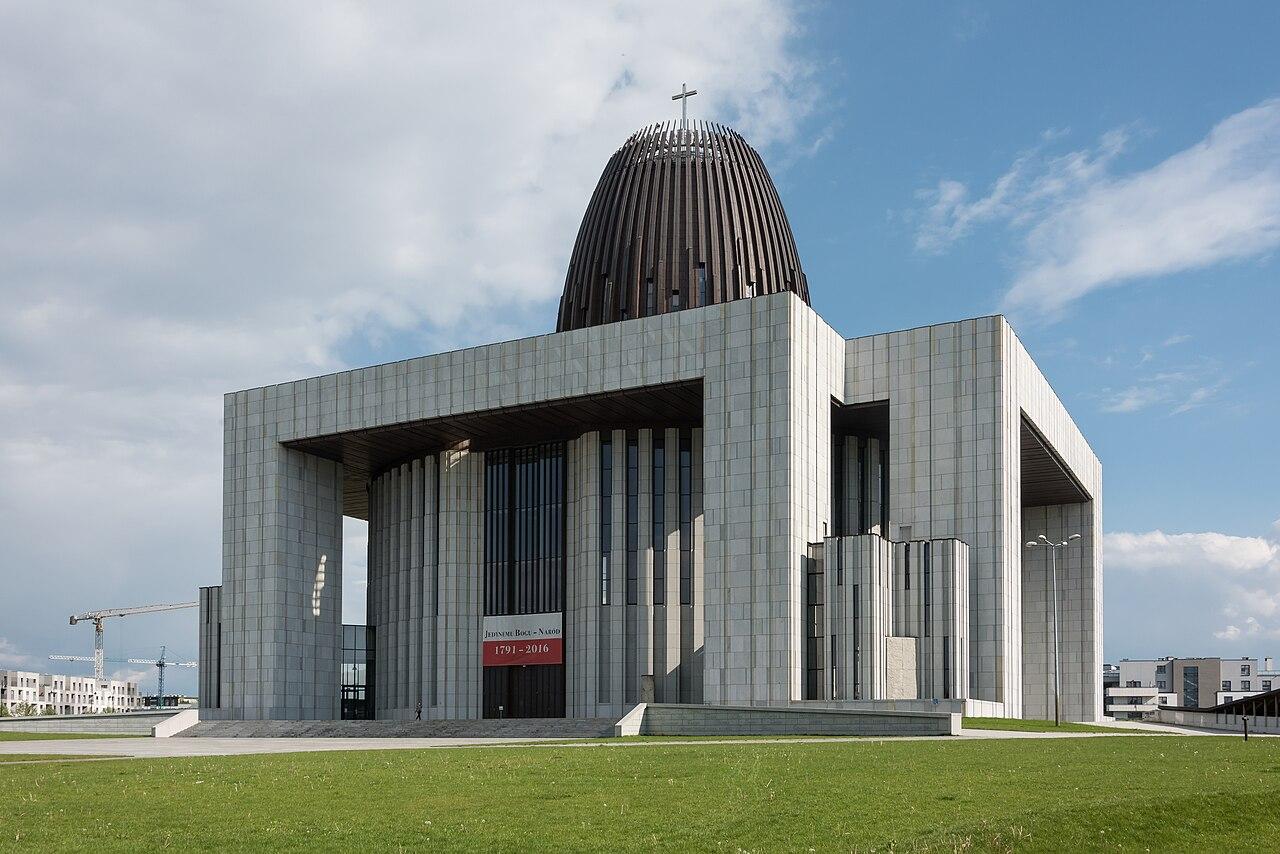
On the western edge of Wilanów, at ul. Prymasa Augusta Hlonda 1, stands a building that is hard to miss from several kilometres away. The Temple of Divine Providence (Świątynia Opatrzności Bożej) rises 75 metres including its cross, making it the tallest sacred building in Warsaw. It sits on the plan of a Greek cross measuring 84 by 84 metres, and its dome is covered in 30 tonnes of copper.
The history of the site is longer than the building itself. The Four Year Sejm vowed to raise the temple as early as 5 May 1791, as a votive offering of gratitude for the passing of the Constitution of 3 May. That triggered the first architectural competition in Polish history, and the winning design by Jakub Kubicki was never built, blocked by the partitions of Poland that followed. In 1929 the Sejm of the Second Polish Republic returned to the idea and announced a new competition, decided a year later with three equal top prizes, but the outbreak of war interrupted the plans again. The modern history began in 1999, when the Association of Polish Architects launched an open competition. In April 2000 Primate Józef Glemp chose the design submitted by Marek Budzyński's team, and after a further competition in 2001 the building actually constructed was designed by the studio of Wojciech and Lech Szymborski. The temple was officially opened on 11 November 2016.
The Pantheon of Great Poles and the viewing terrace
The lower part of the temple houses the Pantheon of Great Poles (Panteon Wielkich Polaków), a place of burial and remembrance for people of merit to Poland. Among those resting there are the priest and poet Jan Twardowski, Father Zdzisław Peszkowski, chaplain of the Katyń Families, Krzysztof Skubiszewski, the first foreign minister after 1989, and Ryszard Kaczorowski, the last president of Poland in exile, along with victims of the Smolensk plane crash of 10 April 2010. The Pantheon also holds a replica of John Paul II's tomb from the Vatican, with the handkerchief used to wipe the pope's face on the day he died, and the relics of Father Jerzy Popiełuszko, murdered by Security Service officers on 19 October 1984.
Under the dome, on the level of the eighth floor, 25 metres above ground, sits the Museum of John Paul II and Primate Wyszyński. Higher still, on the viewing terrace 30 metres above ground, opens one of the highest publicly accessible views over Warsaw outside the strict city centre.
The temple and the Pantheon are visited with a guide, Monday to Saturday from 10 am to 5 pm on the hour, until 4 pm on Wednesdays and the first Friday of the month, and from early afternoon until 5 pm on Sundays. Group tickets are sold at the information point, open daily from 10 am to 5 pm, priced at 75 zloty for a group of up to 25 people, 150 zloty for up to 50, and 220 zloty for larger groups. It is worth booking ahead, by phone at +48 883 343 040 or by email at zwiedzanie@centrumopatrznosci.pl.