This is the English version of an article first published in Polish: read the Polish original.
Anyone driving along Aleja Rzeczypospolitej toward Kieślowskiego passes it without stopping. Anyone who turns off the road finds a park that architects designed with an ambition rarely seen on an ordinary residential street.
Oś Królewska was built in 2006-2007, alongside the expansion of Miasteczko Wilanów. Its name points directly to its neighbour: it's from here, from beneath the Palace of Jan III Sobieski, that the whole district took its title. The street has two carriageways and runs from Aleja Rzeczypospolitej to the junction with ul. Kieślowskiego. Together with Aleja Wilanowska, Aleja Rzeczypospolitej and ul. Klimczaka, it forms the system of compositional and view axes on which the whole of Miasteczko Wilanów was planned. Urban planners call this layout "la patte d'oie" (the goose's foot), three view axes radiating outward from one point.
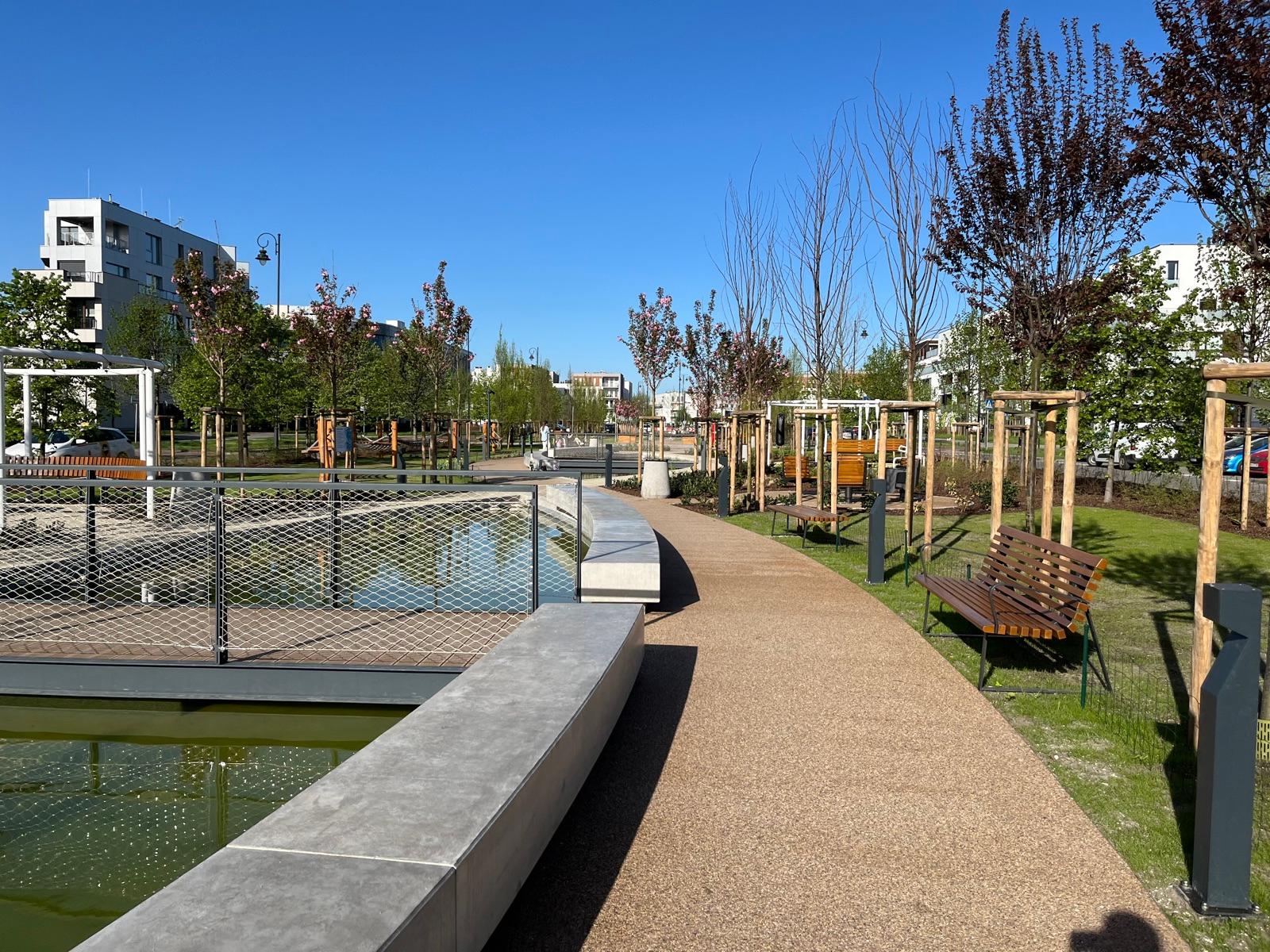
The street itself isn't the real attraction though, the park running along its entire length is. Three ponds stretch out one after another, framed by a metal structure shaped like a DNA helix, a motif rarely seen in Warsaw's public greenery. Benches and outdoor exercise equipment line the path, and a bridge over the water lets you cross from one side of the park to the other without walking around the pond.
What else is worth knowing before you go for a walk
The park is practical, not just scenic. Two medical clinics, Przychodnia Wilanów and Przychodnia CITYMED, have their premises along Oś Królewska, so for some residents this is a route they cover regularly anyway, just on the way to a doctor's appointment rather than for a stroll.
For someone just moving into Miasteczko Wilanów, Oś Królewska is a good test of whether the area suits them: a park a few minutes' walk away, benches to rest on, and exercise equipment without leaving the district. For longer term residents, it's one of the streets that has changed the most, from an empty field twenty years ago into a dense, green axis that hundreds of people now run along, walk their dogs on and push strollers through every day.