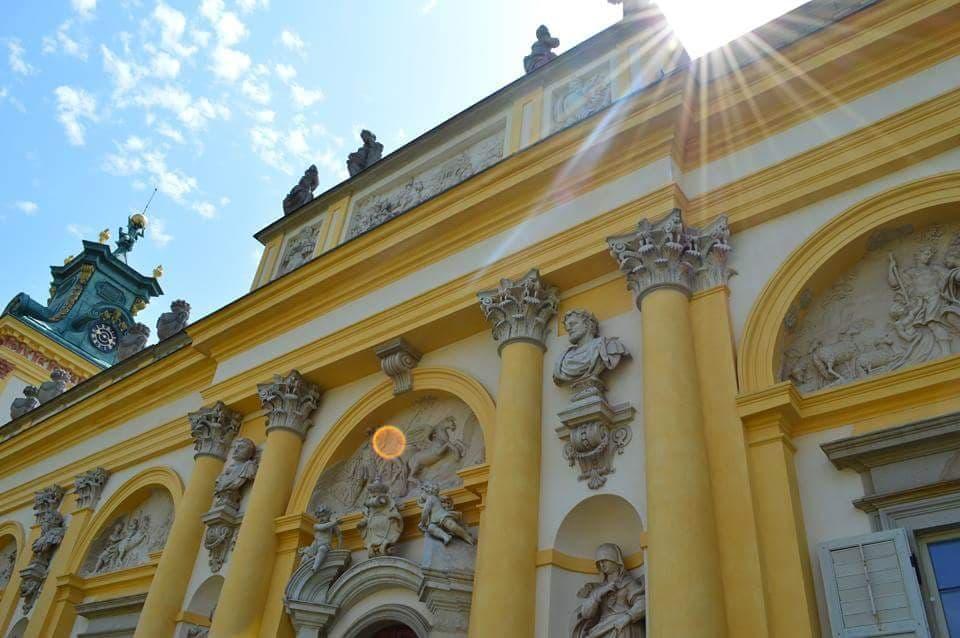
This is the English version of an article first published in Polish: read the Polish original. It refers to source material: wilanow-palac.pl. The text is our own commentary, not a translation or copy of that source.
In the right wing of Wilanów Palace, in basements that once served the estate's household economy, the Royal Printing House now operates. It is a living recreation of a seventeenth century print shop, not a display case with a caption. A printer in period costume runs a genuine press, explains how every page of a book was made a hundred years before steam powered machines, and lets visitors handle the old type themselves.
The show is short but interactive from start to finish. Children and adults can pick up metal type, arrange it into a short text on a small calling card, and print it together with the printer on a real press. Along the way comes a fact worth remembering: Jan III Sobieski, the palace's owner, took a field printing press with him on his military campaigns, so printing has a longer history in Wilanów than it might seem.
What it costs and when to go
The Royal Printing House runs on Thursdays, Saturdays and Sundays, from 11am to 4pm, and admission is included in the regular palace ticket, with no extra fee. Thursday is the best day to go, since the palace itself is free to visit that day and the printing house happens to be open too, so the whole visit costs nothing beyond getting there. On other days a standard ticket costs 35 PLN Monday to Thursday and 55 PLN Friday to Sunday, with reduced tickets at 25 and 35 PLN respectively, and children under six enter free. The palace itself is open every day, Thursday to Tuesday from 10am to 4pm and Wednesdays until 6pm.
The address is ul. Stanisława Kostki Potockiego 10/16, and the entrance to the printing house is in the basement of the right wing, near the ticket desk and cloakroom. It is one of those attractions easy to forget when planning a visit around the state rooms and the garden, but worth setting aside half an hour for, especially with a child who likes to make something with their hands rather than just look.