This is the English version of an article first published in Polish: read the Polish original.
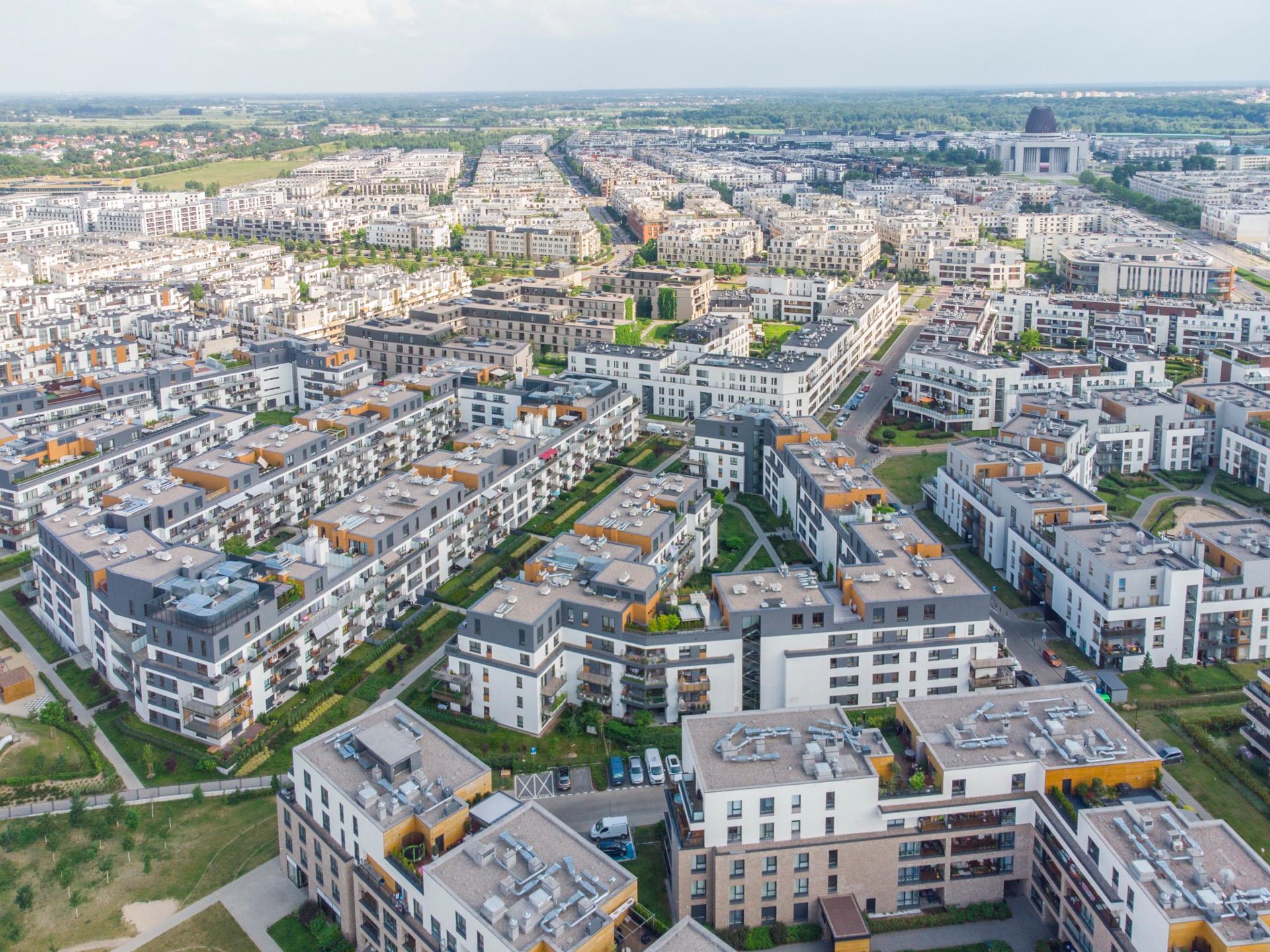
In 2010, Wilanów had around 17,000 residents. Today, sixteen years later, there are close to 45,000. That is growth of more than 160 percent, in a district that has not changed its boundaries or absorbed any neighbouring area in that time. This is not natural demographic growth. It is the result of one specific process: building a new town on fields that, as recently as the 1990s, were simply the edge of Warsaw.
For comparison, no other district of the capital grew this fast in percentage terms over the same period. Białołęka grew at a similar pace, but from a completely different base and in a different urban layout: scattered single family housing, not a compact new town with a shopping centre, schools and office buildings within a few hundred metres.
What this growth means in practice
You can see it from street level, not only in the statistics from the national statistics office (GUS). Infrastructure is still catching up with the population, not the other way round. Schools, kindergartens and public transport were designed for a district two or three times smaller than it is today. That is why there are queues for public kindergartens, and why the commute to the metro now takes so long at rush hour.
Wilanów has also moved on from being a "new development project" to being an established district with its own identity. Fifteen years ago, people bought a flat here because it was cheap and something new was being built nearby. Today, people have lived here for a decade, are raising children who finish school locally, and have no plans to move away.
Wilanów has stopped being a development project and become a district with its own history of residents.
And this is the part that directly concerns the property market: population growth this large and this fast, combined with a limited supply of new building plots, has to show up somewhere. Price pressure does not come from nowhere. It comes from demand growing faster than the number of available flats, especially recently, as the pace of new developments in Miasteczko Wilanów has clearly slowed compared to the peak in the middle of the previous decade.
Why this matters if you are looking for a flat here today
If you are considering buying or renting in Wilanów, it is worth understanding that you are buying into a mature, increasingly dense community, not just square metres. That has its upsides: developed family infrastructure, shops, restaurants, nurseries. It also has its downsides: fewer new listings available, and price pressure that is unlikely to disappear as long as Warsaw as a whole keeps growing.
Population figures rarely make it into a sale listing, yet they say more about where prices are heading than many a market report. Wilanów has nearly tripled in size because people stay here. That is the simplest forecast anyone can make for the years ahead.